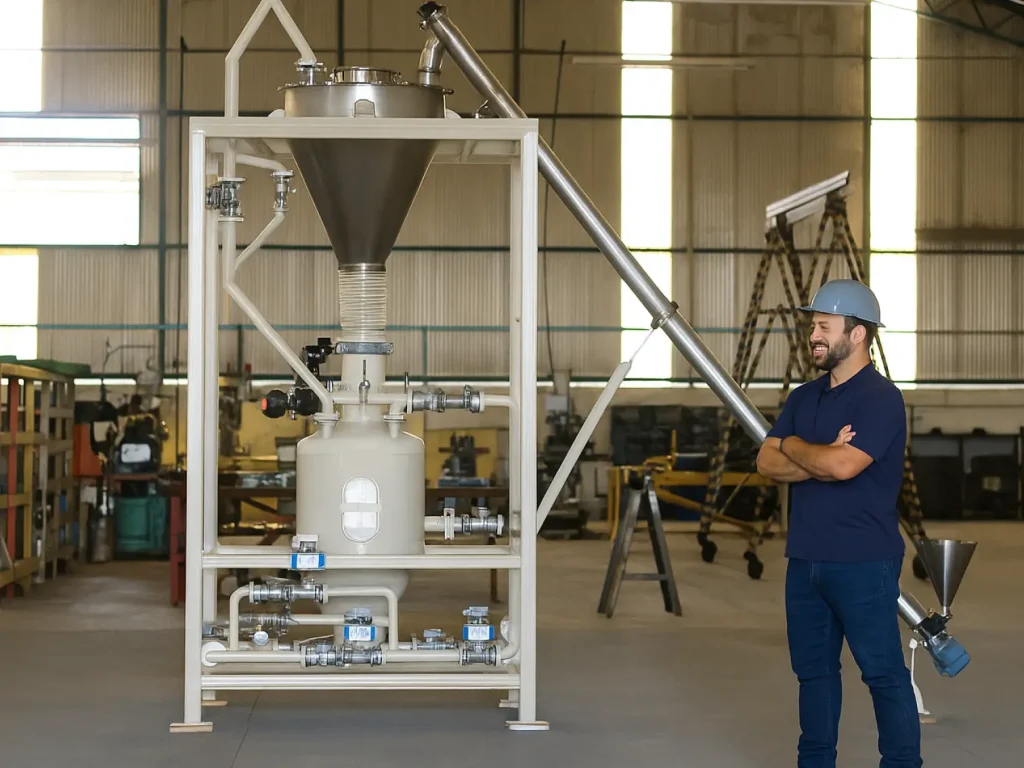
Pneumatic conveying moves powdered or granular materials, and it can be the best solution for a wide range of industrial plants.
After all, you need to ensure high productivity, quality and reliability across the widest range of raw material and finished product processes.
That’s what can happen with a system designed to use pressure and airflow to move bulk or powdered materials between areas with excellent cost-effectiveness.
However, there are variables that can affect both productivity and the product itself.
For this reason, it’s important to understand what pneumatic conveying is, along with its historical development and its main applications in industry.
So, What Is Pneumatic Conveying?
To understand what pneumatic conveying is, it’s worth taking a step back to look at the history of this technology.
It all began in the 19th century, when researchers started studying the role of air pressure in moving products.
Over time, Lamson pipes, or capsule pipes as they were also called, proved efficient, based on the following definition:
“Networks of tubes with cylindrical containers driven by compressed air or vacuum.
So there are several advantages to this approach compared to mechanical movement, such as elevators, drag chain conveyors, screw conveyors, and so on.
This air-based system offers greater safety and quality for the process, among other benefits.
In Industry
As a result, over the last two decades we’ve seen the success of pneumatic conveying in industry. The system has proven efficient at boosting productivity, for example.
The concept behind this system is the key to this technology, since it makes it possible to control degradation and the efficiency of material transfer and processing.
In this context, it’s easy to see that the system allows for:
“Moving powdered or granular materials from one point to another through piping that uses compressed air in a fully sealed way.
So the main advantages are:
- Fast, continuous transport, integrating multiple processes and areas;
- Flexibility in moving materials (powders, grains, bulk materials, etc.);
- Less need for specialized labor and a healthier work environment (less dust);
- Controlled transport that avoids contamination;
- Lower cost by minimizing damage to products.
To further understand the theory, keep in mind that there are basically two concepts related to industrial pneumatic conveying: dense phase and dilute phase.
The choice between the two depends on the application and the material being handled, as well as the goals involved.
To learn more: find out how a pneumatic conveying system works.
Now let’s look at how this type of transport is applied, and in which segments.
Applications of Pneumatic Conveying
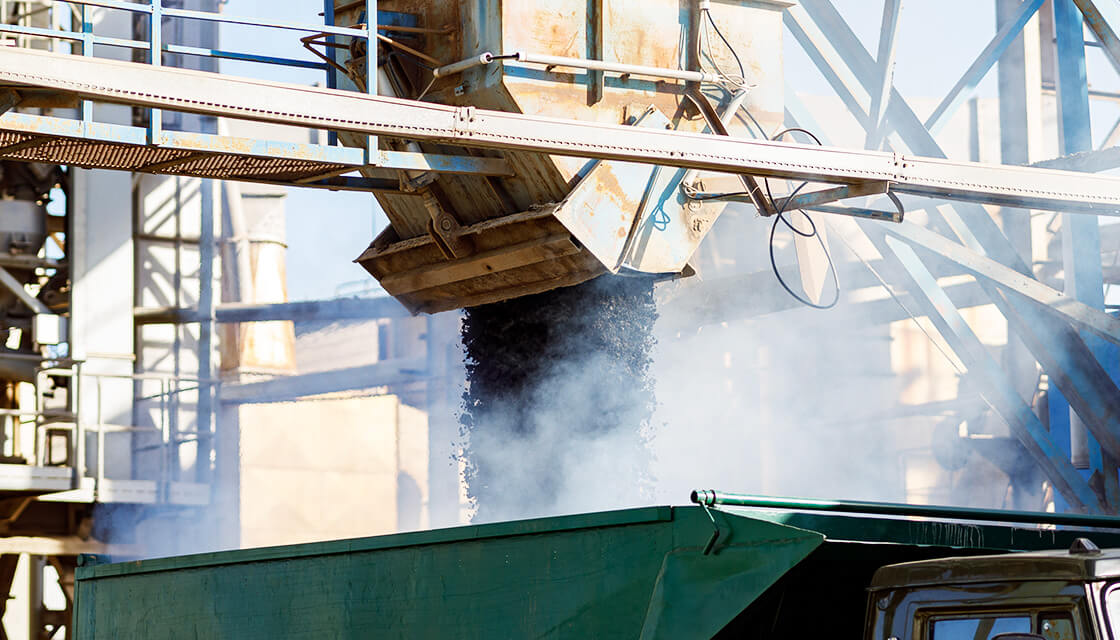
As we’ve seen, industrial pneumatic conveying is a highly versatile system with many advantages.
With that in mind, among its many uses, the main applications are:
- Feeding cement, lime, and various food product silos;
- Feeding machines with small parts or granulates for extruders;
- Transporting dust and sawdust in the timber industry;
- Mixing and weighing systems;
- Re-injecting coal into combustion for boiler furnaces;
- Loading and unloading train cars and ships/vessels;
- Transfers between trailers;
- Transporting paper trim, as well as tubes and caps.
Beyond this wide range of applications, and many others, keep in mind that this system has low maintenance costs, since it’s very robust and experiences little wear.
Industries That Use This Type of Technology
Pneumatic conveying systems are designed so that products are transported safely, cleanly, and with minimal contamination risk.
That’s why it’s widely used across industries such as:
- Food;
- Cement;
- Transshipment;
- Pharmaceutical;
- Grain;
- Timber;
- Mining;
- Animal nutrition;
- Port operations;
- Chemical, and more.
Each company has its own particular use for this technology, from moving grains and flours to transporting powders in chemical processes.
That’s why it makes a lot of sense to have a design built for each industry’s specific needs.
You need to consider the factors that influence choosing the best pneumatic conveying solution, such as the equipment to be used and the materials to be transported.
For example, you need effective moisture control for products to prevent contamination.
So only qualified engineers and a specialized company are able to deliver this kind of solution, one that’s this well-suited and customized for your business.
Pneumatic Conveying Is a Job for Globe
We are Globe Systems, a company that has been active in the market since 2002, providing integrated technology solutions to optimize industrial processes.
We operate across multiple segments with complete know-how in pneumatic conveying systems, dust and grain handling, and dust collection systems.
We’re the ideal partner to optimize your company’s production processes, increase safety and promote sustainability.
Visit us, learn more, and get in touch with one of our representatives:

Fun Fact: Pneumatic Conveying in Pop Culture
If you’re a fan of literature, you may have already read about Jules Verne’s “transoceanic tubes” or “underwater transport tubes.”
This idea, so futuristic for its time, was quite similar to pneumatic conveying.
Today, we have much more modern projects that partly use concepts dating back centuries, such as Hyperloop, or the “capsule transport” concept from Elon Musk.
Another way this type of transport shows up in fiction is through The Jetsons and Futurama. Both cartoons featured this technology to move people and/or objects.
In the real world, in 1853 a connection was built between the London Stock Exchange and the city’s telegraph station, a distance of 200 meters.
That’s how the technology gained notoriety, when companies started using it to urgently transport small packages, similar to mail delivery.
This postal service became known as pneumatic mail, a system for sending letters through pressurized air tubes, invented by William Murdoch.
Later, in 1866, a pneumatic system was designed to transport people in London. As we all know, the idea was abandoned.
As a form of public transportation, pneumatic trains never really got off the ground, with plans to connect London and Paris to nearby cities within a maximum of 20 miles.
Did you enjoy this content? See more on the Globe Systems blog.