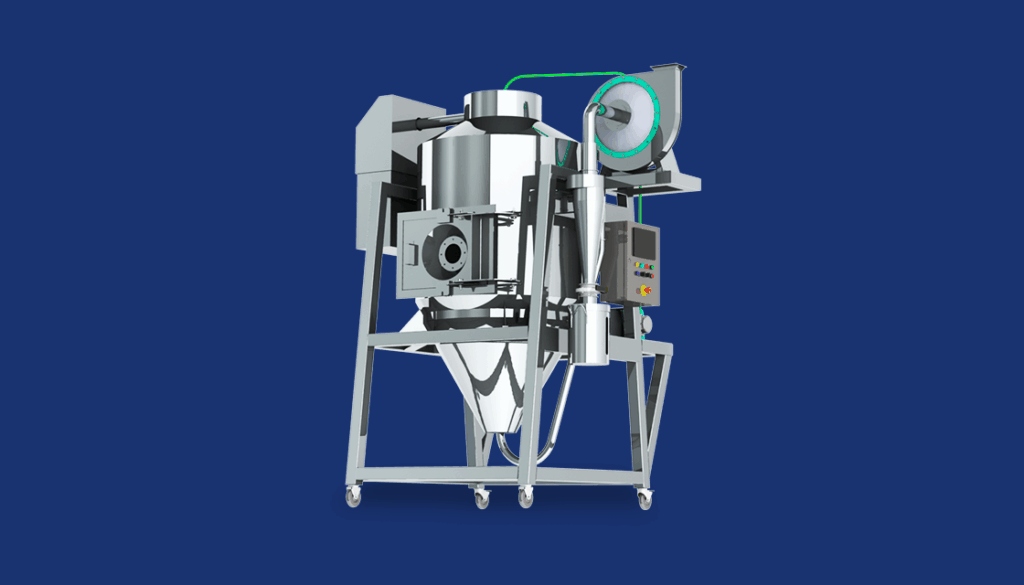
Widely used across many industrial processes, spray drying is essential. This drying process makes it possible to turn a wide variety of liquids into powder, standardizing them with a residual moisture content tailored to each need.
Ideally, the spray drying process should be versatile and support high productivity, with the ability to produce larger or smaller droplets and to increase or decrease density, for example.
But there are some problems that can occur during this process. The result can be a lower-quality or out-of-spec product, which can even drive up production costs.
Check out this short guide on how spray drying works, along with the main problems that can occur. You’ll also find the steps to solve each one.
Spray Drying: What Is It?
By technical definition, the Spray Dryer is a process for turning a fluid (liquid) into a solid material, atomizing it into small droplets within a hot drying medium.
This process begins with spraying the product inside a chamber, which is subjected to a controlled stream of hot air. The result is the vaporization of the water contained in the fluid, and consequently the ultra-fast separation of solids and solubles.
In other words, in this process the liquid product dries instantly through atomization, always without thermal shock. This turns it into an extremely fine, uniform, standardized, high-quality powder.
Most Common Spray Dryer Problems: What Are the Possible Solutions?
As mentioned earlier, industry can face certain problems related to its drying production line. These compromise standardization, causing the final product to show, for example, a higher moisture content than expected.
These occurrences show that spray drying isn’t happening as intended. But there are solutions industry can adopt.
Below are the most common problems, along with the steps to fix each one.
1. Wet Walls
At the end of the spray drying process, the chamber walls can end up wet, and this problem hurts productivity.
This problem can have three causes. The first is a spray angle that’s too wide — narrowing it can already solve the problem. Another cause is low pressure, which can be fixed by increasing the pressure.
There’s also a third factor related to a drying temperature that’s too low, requiring an increase in temperature to solve it.
2. High Product Moisture
Here’s an example: at the end of the drying process, a product that should have 2% moisture instead shows 10%, indicating excess moisture and a problem. One of the most obvious causes is low temperature, which is solved by raising it.
But you also can’t rule out the use of a nozzle with a flow rate above the Spray Dryer’s design specification, which directly affects droplet size. In this case, the nozzle size needs to be readjusted.
Finally, low pressure can also be causing the product’s excess moisture, and the solution is to increase it.
2. Low Product Moisture
The opposite problem can also occur: a product that should show around 10% moisture at the end of the spray drying process ends up with 5%, meaning it’s drier than it should be.
In this case, excessively high temperature can be a cause, requiring it to be lowered. In addition, droplet size may be smaller than the product’s specification. This can happen due to low nozzle capacity, pressure above the process set point, and excessive nozzle wear.
So replacing the nozzle and reducing pressure can help solve this problem.
4. Fouling
The buildup of fouling material on the nozzle responsible for atomizing the product is another problem that can arise in the equipment.
This problem is related to the dryer’s environment, the nozzle’s location, and the airflow rate. The nozzle design — including the cap’s geometry, shapes, and angles — can also be a cause. To solve this problem, replacing and cleaning the nozzles can help.
Finally, companies always need to acquire equipment capable of delivering efficiency, durability, safety, and, above all, strategic results. In this scenario, Globe Systems is proud to offer the most modern and efficient Spray Dryer drying equipment on the market.
Want to know more? Then find out whether the number of drying passes also affects the characteristics of the powder produced by the Spray Dryer.