The wastewater treatment is one of the biggest operational and environmental challenges in modern industry. Plants in the chemical, food, pharmaceutical, and mining sectors generate large volumes of residual liquids that must be treated before disposal, and the cost of transporting, storing, and disposing of this wastewater weighs increasingly on the budget. Industrial evaporation stands out as one of the most efficient technologies for reducing this volume and, in many cases, recovering process water.
Concentrating and separating the aqueous phase of the waste is the principle that connects wastewater treatment to industrial concentration evaporation. By removing water, the volume to be disposed of drops drastically, and what remains is a much smaller concentrate, cheaper to transport and dispose of properly, and in some cases suitable for reuse.
Why Wastewater Treatment Weighs on Industrial Cost
The central problem is not the waste itself, but the volume of water it carries. Paying for freight, storage, and disposal of tons of liquid is a logistical inefficiency that repeats with every batch produced. Beyond the direct cost, there is regulatory risk: improper disposal can jeopardize the plant’s operating license and result in fines. That’s why wastewater treatment has stopped being just a compliance requirement and has become a strategic decision for cost reduction and operational continuity.
How Evaporation Works in Wastewater Treatment
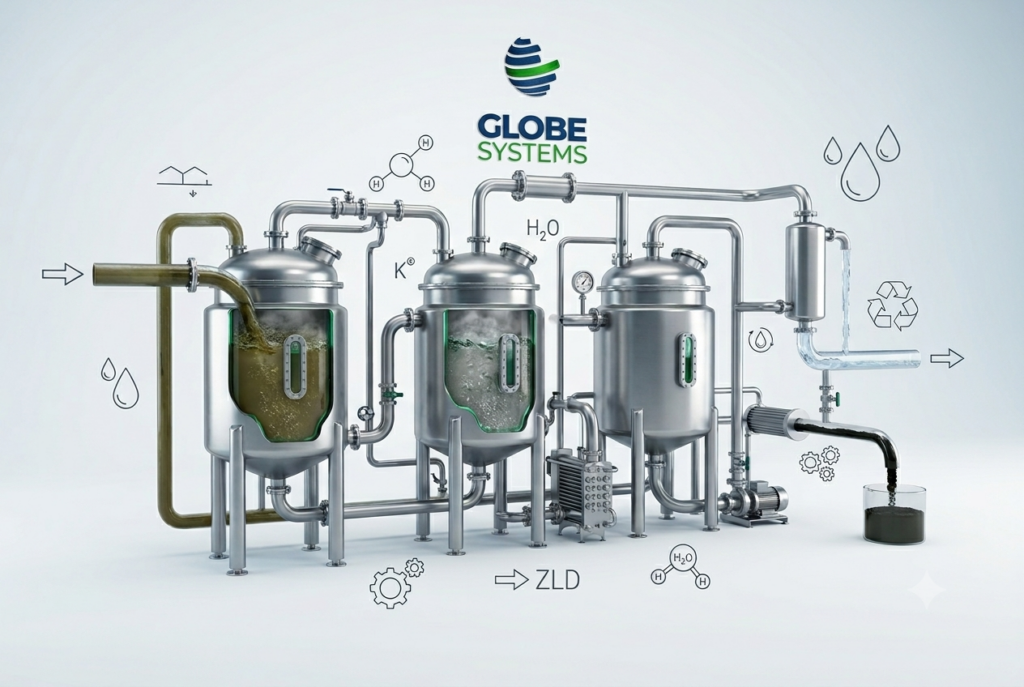
Evaporation applies controlled heat to the wastewater to vaporize the water, separating it from dissolved solids and contaminants. The vapor is then condensed, generating high-purity water for reuse, while the concentrate proceeds to final disposal. The process can operate under vacuum, which lowers the boiling temperature and energy consumption — an important advantage for heat-sensitive, scaling, or corrosive effluents, which require additional design care.
Volume Reduction in Wastewater Treatment
Evaporation’s biggest contribution is volume reduction. Depending on the initial concentration of the wastewater, it is possible to reduce the volume by 80% to 90% or more, turning large flows into a compact concentrate. In practice, this means fewer trucks, fewer drums, and lower disposal costs — a direct, measurable impact on operating cost per unit produced. The greater the water cut, the greater the logistical savings over time.
Water Reuse and the ZLD Concept
When the goal is to completely eliminate liquid discharge, it’s called ZLD (Zero Liquid Discharge). In this approach, evaporation concentrates the wastewater to its technical limit, and the recovered water returns to the process — into cooling towers, washing systems, or reinjection. Beyond the obvious environmental gain, reuse reduces intake of new water, an increasingly scarce, expensive, and regulated resource in many regions of the country.
Energy Efficiency: Multiple Effect and MVR
Since evaporation consumes energy to vaporize water, energy efficiency is decisive for project viability. Technologies such as the multiple-effect evaporator reuse the vapor generated across successive stages, reducing utility consumption with each effect. Mechanical vapor recompression (MVR), meanwhile, reuses the process’s own vapor, compressing it to recover its energy instead of discarding it. The choice between these configurations depends on flow rate, local energy cost, and wastewater characteristics, and directly impacts the treatment’s operating cost over the years.
Before evaporation, many effluents require pre-treatment steps — oil removal, pH adjustment, or removal of coarse solids — to protect the equipment and stabilize operation. Skipping this step is one of the main causes of scaling and premature corrosion. That’s why a good design evaluates the effluent end-to-end, not just the evaporator in isolation.
Advantages of Evaporative Wastewater Treatment
Adopting evaporation as a treatment route brings benefits that go beyond environmental compliance:
- Drastic volume reduction: less transport and external disposal logistics.
- Water recovery: reuse of the aqueous phase, reducing intake of new water.
- Lower environmental liability: the final concentrate is simpler and cheaper to dispose of.
- Environmental compliance: legal certainty for maintaining the operating license.
- Operational predictability: continuous, automatable, and controllable process.
To correctly size a system, several technical variables need to be carefully evaluated:
| Variable | Influence on Wastewater Treatment |
|---|---|
| Solids concentration | Defines the evaporator’s configuration and material |
| Chemical composition | Determines the need for pre-treatment |
| Feed flow rate | Basis for system sizing |
| Corrosiveness | Defines the equipment’s metallurgy and protection |
| Operating temperature | Impacts the process’s energy efficiency |
A well-designed system also incorporates appropriate instrumentation and automation: conductivity, level, and temperature sensors allow the evaporator to operate stably and safely, adjusting the process to natural variations in the effluent’s load and composition. This level of control reduces the need for manual intervention, prevents unplanned shutdowns, and ensures that the recovered water consistently maintains the quality standard required for reuse within the plant.
Does your plant handle large volumes of wastewater?
Globe Systems sizes evaporators by process, based on the real characteristics of your wastewater. Talk to Our Specialists and receive a technical analysis for your application.
Industrial Applications and Environmental Compliance
The wastewater treatment by evaporation serves diverse sectors: chemical, pharmaceutical, food, mining, and oil. A clear example is produced water treatment and brine management in the oil and gas sector, where high volumes of saline wastewater are concentrated to reduce logistical costs and make mature production fields economically viable.
In all these cases, the treated effluent and recovered water must meet the quality standards required by water resources legislation, in line with the guidelines of agencies such as the National Water and Basic Sanitation Agency (ANA). Designing the system with these limits in mind from the start avoids rework, fines, and the need for costly adjustments after installation.
In mining, evaporation concentrates process and drainage water to reduce the liability stored in dams and containment basins. In the chemical industry, it recovers solvents and treats saline streams that are otherwise difficult to dispose of. In each of these applications, the gain combines three fronts at once: volume reduction, resource recovery, and compliance with discharge limits set by environmental authorities.
The Globe Systems Solution for Wastewater Treatment
Globe Systems designs custom evaporators and concentrators for wastewater treatment industrial wastewater treatment, with consultative sizing by process, not by catalog. Every system is defined based on the effluent’s real characteristics: concentration, chemical composition, corrosiveness, and feed flow rate. The result is equipment that’s robust against corrosion, with maximum energy efficiency and a safety factor applied to the design. The company is also backed by BNDES accreditation to enable financing for the industrial investment.
Turning wastewater treatment from a liability into an opportunity for cost reduction and water reuse is, above all, an engineering and strategic decision. With properly sized industrial evaporation, the plant reduces volume, recovers resources, and protects its operating license. In the end, what was once a recurring expense becomes efficiency for the operation.