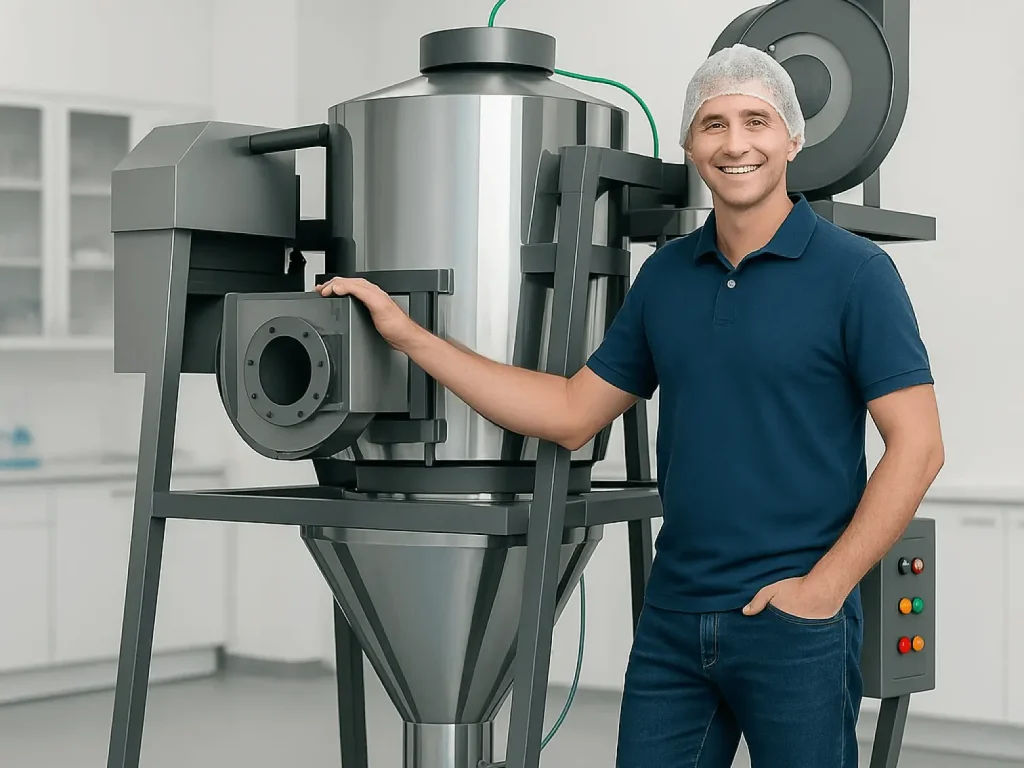
Freeze-drying is a very common drying technique in industry. It’s characterized by water passing directly from the solid state (frozen) to the gaseous state, without going through the liquid state. But did you know there’s another process with a similar function known as the spray dryer technique, which delivers excellent results?
Considered a process similar to freeze-drying, but with a simpler approach, the spray dryer technique (also called atomization) is a very interesting alternative for various industries, particularly for increasing the stability, temperature tolerance, and shelf life of biopharmaceutical and food products, always with the best cost-benefit ratio.
So it’s important to understand what freeze-drying is and why replacing it with the spray dryer process can be an excellent option for industries seeking greater efficiency in drying processes.
Freeze-Drying: An Efficient Drying Process, But With Some Drawbacks
Freeze-drying is a drying process based on sublimation phenomena, recommended for preserving food and other heat-sensitive products.
In this process, the water contained in various products to be freeze-dried passes directly from the solid to the gaseous state — without going through the liquid state.
Compared to heat dehydration, the main advantage of freeze-drying is the ability to preserve all of a product’s characteristics, properties, and physical and nutritional structures — meaning only the water is removed through this process.
The freeze-drying process is divided into three stages: first the material is frozen, then subjected to temperature and pressure below water’s triple point, allowing the water to be initially removed by sublimation (primary drying).
Right after that, drying continues through desorption (secondary drying) until the desired final moisture content is reached for the product in question.
In terms of yield and final product quality, freeze-drying is considered one of the most efficient dehydration techniques, but it does have some drawbacks that need to be considered, such as:
- It requires expensive equipment that takes up a lot of space and consumes a lot of energy;
- It’s a method that takes a relatively long time, sometimes taking several days to complete;
- If the final product needs to be a powder, a granulation process has to be added at the end.
As an alternative to these problems, many companies are starting to choose spray dryers, whose characteristics are more advantageous, as we’ll see below.
Spray Dryer: The Best Alternative to Freeze-Drying
As a replacement for freeze-drying, another process that can be used and that delivers great efficiency is the spray dryer (or spray drying).
The spray dryer works in a fairly simple way: it dries different liquid products using a controlled stream of hot air, which is forced by fans into a drying chamber of a predetermined volume.
This hot air stream is controlled, allowing the entire product being processed to be dried. As a result, the micro-droplets produced by atomization are instantly vaporized when they come into contact with this hot air stream.
Spray drying can be divided into four phases:
- Liquid atomization;
- Contact of the atomized liquid with the hot air;
- Water evaporation; and
- Separation of the powdered product from the drying air.
These operations need to be monitored, since all of them have a major impact on the final product’s quality.
Main Advantages of Spray Drying Over Freeze-Drying
Compared to freeze-drying, spray drying is a much simpler process with a higher processing rate. It’s also scalable and can produce powders suitable for processing into tablets/capsules, all in a single process, without the need for milling or any other secondary processing.
That secondary processing is required in freeze-drying, where material size can only be reduced through milling, which drives up costs.
In addition, spray drying makes particle engineering much easier to carry out. By adjusting process parameters, a company can fine-tune various particle properties, such as size distribution, dispersibility, and surface enrichment of biopharmaceuticals.
Spray drying also offers a better cost-benefit ratio, requires less energy, and is adaptable to different types of raw materials.
Discover Globe Systems’ most advanced and efficient food spray drying solution. Click here to learn more.
![[Catálogo] Conheça nossos produtos! | Baixar catálogo | Globe Systems](https://blog.globesystems.com.br/wp-content/uploads/2021/03/catalogo.png "[Catálogo] Conheça nossos produtos! | Baixar catálogo | Globe Systems")