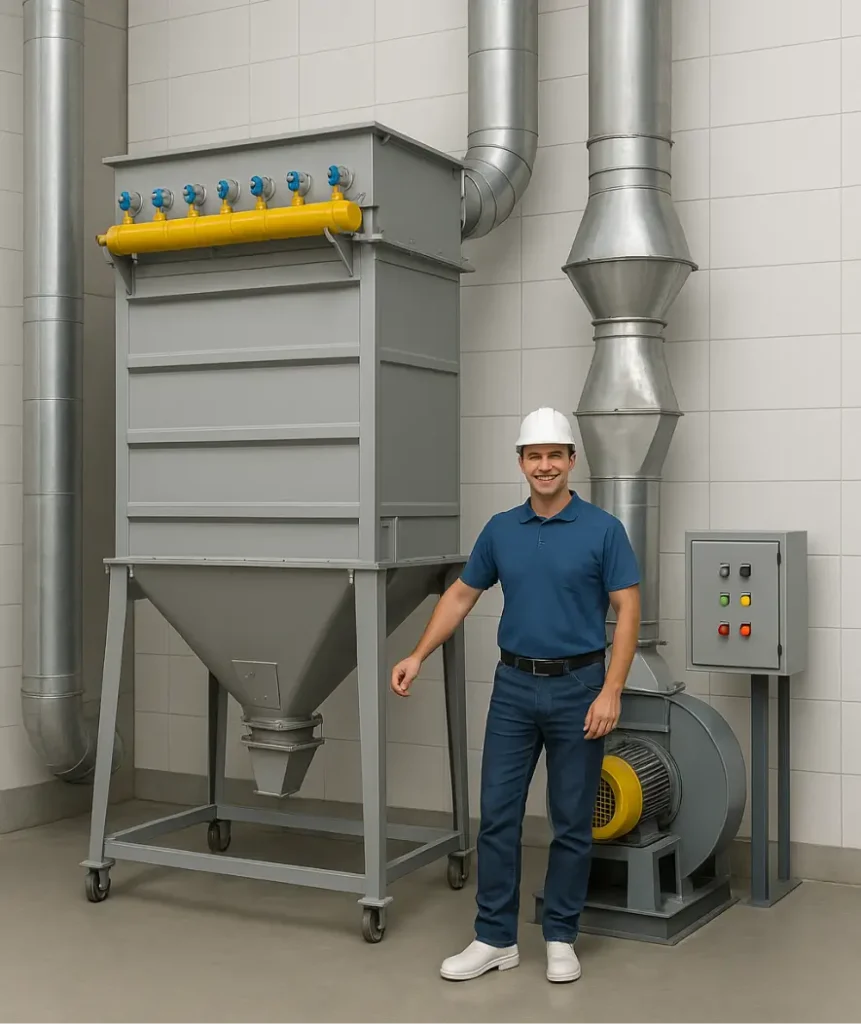
The company you manage generates powders and waste from industrial processes. Did you know that treating and disposing of them correctly is essential? That’s exactly why adopting industrial dust collection systems has become an increasingly common necessity.
Beyond being a necessity, properly treating and disposing of these industrial waste products has become a legal obligation for companies. It is their responsibility to treat waste correctly, disposing of it in compliance with environmental laws and regulations.
Adopting an industrial dust collection system means the company will treat the air before suspended particles released during industrial processes are discharged into the atmosphere, reducing environmental pollution.
Find out what they are, see how they work, and learn about the importance of adopting industrial dust collection systems to improve air quality both inside and outside the company.
What Are Industrial Dust Collection Systems
Many industrial processes have the potential to generate large amounts of waste and dust as a result of the materials used and the methods adopted. To prevent these from causing bigger problems or increasing atmospheric contamination, the use of industrial dust collection systems is a recurring necessity.
Industrial dust collection systems consist of a set of industrial equipment that treats the air before the waste generated is released into the atmosphere. With this system, pollution produced during industrial processes is reduced, preventing unwanted particles from spreading into the environment.
In short, this system’s function is to filter air loaded with waste (dust particles, gases, and all types of suspended fragments), giving it the lowest possible pollution level. This makes it possible to release the air back into the atmosphere.
It is also important to mention that many industries require a good, efficient dust collection system, such as:
- Mining industry;
- Cement industry;
- Chemical industry;
- Food industry;
- Plastics industry;
- Furniture industry.
There are also other segments that generate a lot of particulate waste in their industrial processes and also require this type of system.
How Industrial Dust Collection Systems Work
As seen previously, the industrial dust collection system filters (treats) the air before industrial process waste is released into the atmosphere.
For this system to be properly adopted and function correctly, industry uses certain specific devices, such as air filters, fans, ducts, valves, automatic filter cleaners, pneumatic conveying, hoods, among others.
Basically, this system is made up of collectors and hoods installed at the pollution generation sources. At these sources, dust is captured and carried through a network of ducts to a cyclone-type dust collector or bag/cartridge filter for particulate retention and filtering.
Once clean, the air drawn in by the centrifugal exhaust fan is released into the atmosphere “cleaner,” meeting the standards required by the regulatory body.
In addition, industrial dust collection systems separate dust particles and waste using two different methods:
- Larger particles are captured by a gravitational cyclone that draws them in until they stick to the walls of the collector.
- Smaller particles are captured using bag or cartridge filters.
Why Having a Dust Collection System Is Essential for Industry
Adopting industrial dust collection systems is extremely important for filtering the industrial environment. With these methods, it’s possible to control pollutant emissions, increasing worker safety, boosting efficiency, and reducing costs.
It’s worth noting that environmental legislation and labor regulations make dust collection mandatory in industrial processes; however, implementation brings benefits that go beyond regulatory compliance.
Among the benefits of this type of system in the industrial environment, the most significant are:
- Helps prevent fires and explosions within the industrial plant;
- Reduces the amount of dust suspended in the air (making the air cleaner);
- Makes the industrial environment much safer;
- Considerably reduces the industry’s environmental impact.
Finally, it’s very important to point out that the best operation and performance of this system depend on correct sizing, as well as preventive and corrective maintenance of the filter elements whenever necessary.
It’s also essential to choose a supplier for this system with experience, one that offers integrated solutions, optimizing manufacturing processes across different industrial segments.
To learn more about pneumatic conveying systems, spray dryers, and industrial dust collection systems, we invite you to check out the Globe Systems blog.
![[Catálogo] Conheça nossos produtos! | Baixar catálogo | Globe Systems](https://blog.globesystems.com.br/wp-content/uploads/2021/03/catalogo.png "[Catálogo] Conheça nossos produtos! | Baixar catálogo | Globe Systems")