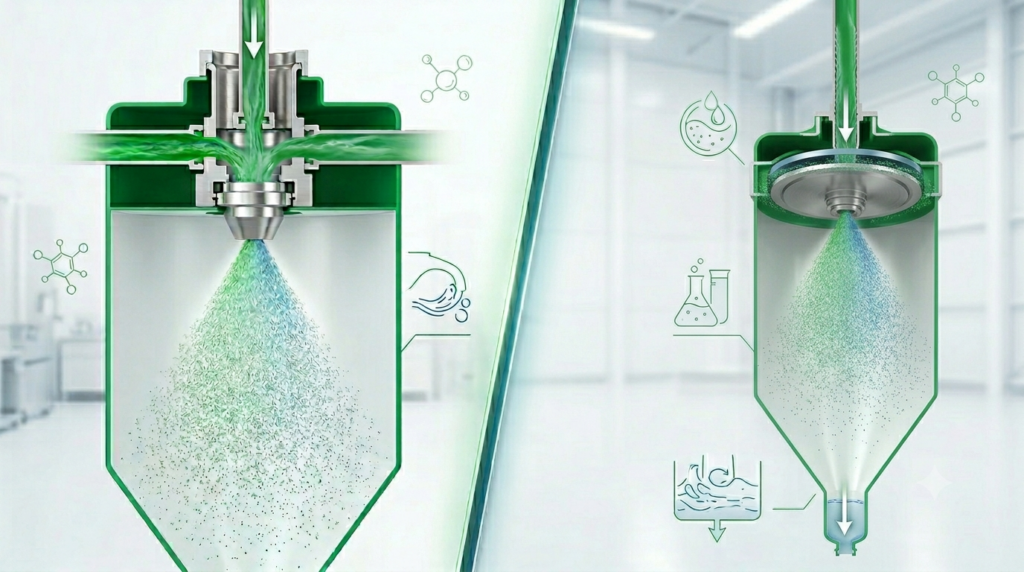
In industrial spray drying, the component that defines the quality of the final powder is the system responsible for breaking up the liquid. The atomizing nozzle is the part that turns the solution or suspension into millions of tiny droplets, and the choice between the atomizing nozzle high-pressure nozzle and the rotary disk determines the investment cost, maintenance frequency, and product standardization. Understanding this difference is the first step toward specifying a spray dryer that is predictable, efficient, and suited to your process.
Atomization is the heart of every industrial spray drying process: it is the instant when the enormous contact area between the liquid and the heated air is created, allowing near-instant evaporation of moisture. The finer and more uniform the mist generated, the more homogeneous and spherical the powder will be — and this is exactly where atomization technology makes a difference to the result.
What Is the Atomizing Nozzle and What Is Its Function
The atomizing nozzle is the device that receives the pressurized liquid and sprays it inside the drying chamber. Unlike systems that rely on mechanical rotation, it has no moving parts at the atomization point: the liquid is broken up by being forced through a calibrated orifice. In practice, this drastically reduces wear points and equipment maintenance complexity. The nozzle’s internal geometry, feed pressure, and fluid properties — viscosity, density, and solids content — define the spray pattern and average droplet size.
How the High-Pressure Atomizing Nozzle Works
In the atomizing nozzle high-pressure nozzle, a pump raises the liquid pressure to ranges that typically vary from 50 to 200 bar. This liquid is then forced through a precision orifice, forming a cone of extremely fine droplets. Operating pressure and orifice diameter directly control droplet size: higher pressure results in smaller droplets and, consequently, more homogeneous final particles. Since it has no components spinning at high speed, the system operates with minimal vibration and a simplified maintenance routine.
Since the atomizing orifice operates under high pressure and constant contact with the product, it is usually manufactured from highly wear-resistant materials, such as tungsten carbide or ceramic, especially in applications with abrasive solids. Another design consideration is feed filtration: coarse particles in the liquid can clog the orifice, and a good system builds in this protection to keep the spray pattern stable throughout the production run.
It’s also worth distinguishing the single-fluid nozzle, where only liquid pressure generates atomization, from the twin-fluid nozzle, which uses compressed air or steam to assist spraying. The single-fluid type, typical of high-pressure systems, is the most common in large-scale industrial production, due to its simpler construction and lower utility consumption. The twin-fluid type is usually reserved for very viscous liquids or lower flow rates, when even finer control over droplet size is needed.
Atomizing Nozzle vs. Rotary Disk: The Technical Comparison
The rotary disk adopts the opposite principle: liquid is deposited onto a disk spinning at extremely high speed, often above 10,000 rpm, and centrifugal force flings the liquid out as droplets. It is a well-established technology in the market, but one that carries important cost and operational implications when compared to the high-pressure nozzle.
Equipment and Maintenance Cost
The rotary disk requires high-speed bearings, a robust drive system, and precise balancing — items that raise both the initial investment and maintenance cost over its service life. The high-pressure nozzle, thanks to its simpler construction, reduces CAPEX and eliminates the main points of mechanical failure. Fewer moving parts mean fewer unplanned shutdowns and higher production line availability.
Powder Standardization and Sphericity
The uniformity of the mist generated by the atomizing nozzle high-pressure nozzle tends to produce particles with greater sphericity and a narrower particle-size distribution. This translates into a powder with better flowability, more consistent density, and more predictable behavior in the subsequent stages of packaging, pneumatic conveying, and product reconstitution. Droplet-size control also directly influences residual moisture: uniform droplets dry evenly, avoiding overheated or still-wet particles within the same batch.
| Criterion | High-Pressure Atomizing Nozzle | Rotary Disk |
|---|---|---|
| Moving parts in atomization | None | High-speed rotating disk |
| Initial investment (CAPEX) | Lower | Higher |
| Maintenance | Simplified | Bearings and drive system require attention |
| Setup and cleaning | Fast | Slower |
| Powder sphericity | High and uniform | Good, with more variation |
Need to specify the ideal atomizer for your process?
Globe Systems sizes every spray dryer by process, not by catalog. Talk to Our Specialists and receive a technical analysis for your application.
When to Specify Each Technology
There is no universally superior technology, only the one best suited to each process. The rotary disk still finds a place in specific situations, such as very viscous products or those with abrasive particles in suspension. The atomizing nozzle high-pressure nozzle is the most efficient choice for the vast majority of industrial drying applications, especially when the goal is the lowest total cost of ownership. correct spray dryer sizing is what connects the atomizer choice to capacity and powder quality goals.
This decision comes up in practically every segment that depends on dry powder: powdered milk and dairy derivatives, instant coffee, powdered egg, food additives, ceramic feedstocks, and active pharmaceutical ingredients. In each of them, particle consistency determines everything from solubility to shelf stability, and the atomization system is the factor that most influences that outcome.
In regulated sectors, such as pharmaceuticals and food, powder standardization has a direct impact on product compliance. Powders intended for medicines and food follow strict quality and traceability requirements, in line with the guidelines of agencies such as ANVISA, which makes atomization uniformity a critical design factor.
The Globe Systems Standard for Atomization
Globe Systems adopts the atomizing nozzle high-pressure nozzle, the spray nozzle, as the standard in its spray dryers, precisely because of the technical and economic advantages discussed. In practice, this means lower initial investment, no moving parts at the heart of atomization, reduced maintenance, faster replacement and cleaning, and greater standardization of the final powder. Every piece of equipment is sized consultatively, by process, with a safety factor applied to the design, and is backed by BNDES accreditation to enable financing. The result is a robust, predictable atomization system aligned with the real needs of each industrial plant.
The decision between the high-pressure nozzle and the rotary disk should start from the product’s characteristics, capacity goals, and total cost over the equipment’s service life. Once these criteria are weighed, the atomizing nozzle high-pressure nozzle stands out as the solution with the best balance of efficiency, standardization, and cost for most industrial drying processes.