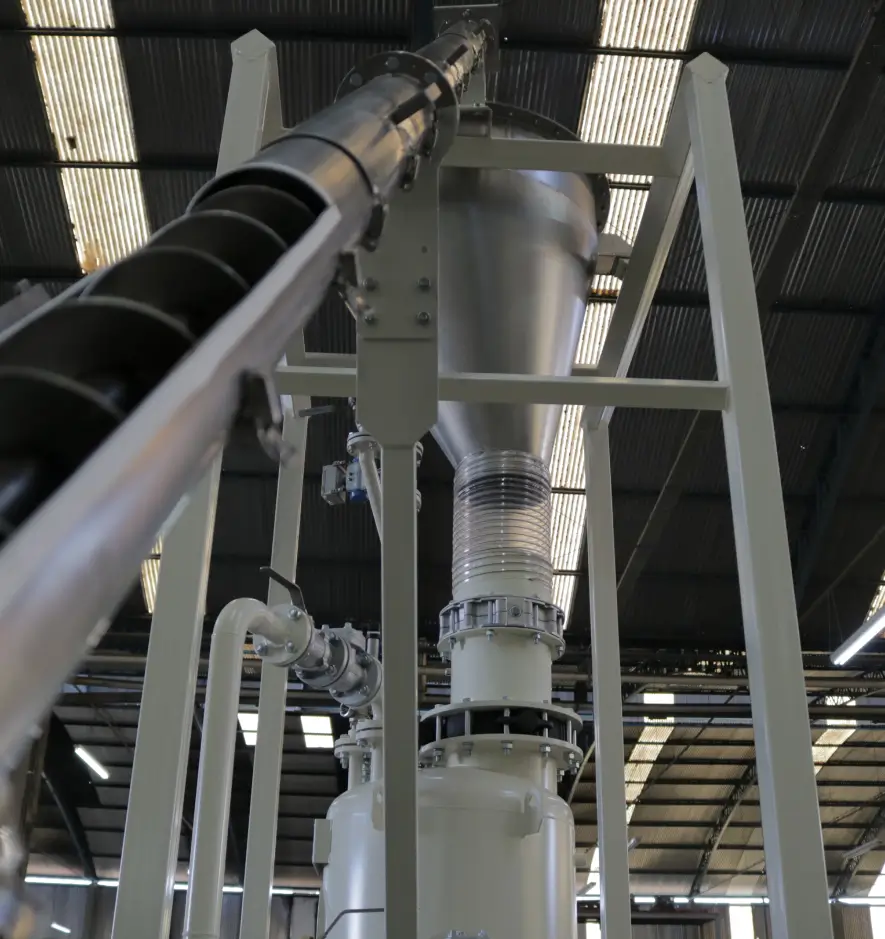
Moving raw materials, inputs, and supplies is a major challenge for industry. This process needs to be carried out efficiently to minimize waste. That’s why investment in pneumatic conveyor systems for industrial processes is becoming more common every day.
These systems represent one of the most important parts of an industrial operation — the process that moves powdered or granular products through piping that’s sealed off from the atmosphere.
Driven by airflow, this system moves products from an origin point to a destination point, always with maximum speed, efficiency, and minimal waste.
But even though it’s a widely adopted system, the question remains: do you know the main advantages and benefits of pneumatic conveyors for the industrial sector? They’re essential for gains in the production process and for maintaining product quality, both for raw materials and finished products.
Pneumatic Conveyor Systems: A Differentiator for Industrial Transport
Pneumatic conveyors, responsible for moving powdered or granular solids using a gas (typically air), represent the most important part of an industrial system.
Using negative pressure (vacuum) or positive pressure, conveyors move products or raw materials from one point to another within the plant through a difference in air pressure. Three variables come into play: air velocity, volume, and pressure.
Because of these characteristics, pneumatic conveyors offer several benefits, especially compared to processes carried out by other forms of industrial transport.
The first advantage is that a pneumatic conveying system can easily cover long distances or major elevation changes, as well as reach high solids flow rates, making it effective compared to mechanical conveyors in many applications.
This transport method has near-zero accident risk, mainly because it carries the material inside piping that’s sealed off from the atmosphere and has no moving parts like other conveyors.
In addition, pneumatic systems are highly durable and reliable, able to maintain constant production flow with less frequent maintenance, as long as they’re properly planned.
This is extremely important, since downtime for unplanned emergency repairs and maintenance is usually harmful to industrial operations.
These conveyors also offer good adaptability to a variety of route layouts and lengths, making them a frequent choice for industries that transport high volumes of material, from fine powders to materials with a coarser particle size, such as pelletized substances. This system can transport particles across a wide and varied range of densities.
But beyond the advantages related to the transport process itself, pneumatic conveyors also offer benefits for the quality of the final product and the raw materials used, as we’ll see below.
Pneumatic Conveyors Help Maintain Product Quality
One particularly interesting aspect of pneumatic conveyors is the complete sealing of the system, which is the foundation of how this type of solution works.
Because of this feature, cross-contamination with elements present in the environment or with other products transported on production lines is reduced, potentially to zero, compared to mechanical conveying systems such as belts, screws, and elevators.
A similar situation applies to the containment of particles inside the system, preventing them from escaping into the plant environment. Because it’s a closed system, built with filters acting as “vents,” there’s no release of product (raw material or input) into the environment. This not only reduces the risk of exposure for plant workers but also increases the safety of both the operation and the final product.
Because of this characteristic, pneumatic conveyors can be used with great economic efficiency in the food and pharmaceutical industries, which are characterized by powder-based materials that can carry a high acquisition value.
Finally, the combined benefits for production and product quality show why pneumatic systems are a robust and effective option, especially compared to mechanical alternatives.
By optimizing productivity through pneumatic conveyors, sustainably and in line with industry standards, companies can increase profitability and carry out their operations in an organized, safe, and efficient way.
To learn more about how pneumatic conveying systems work and their other advantages, follow our blog.