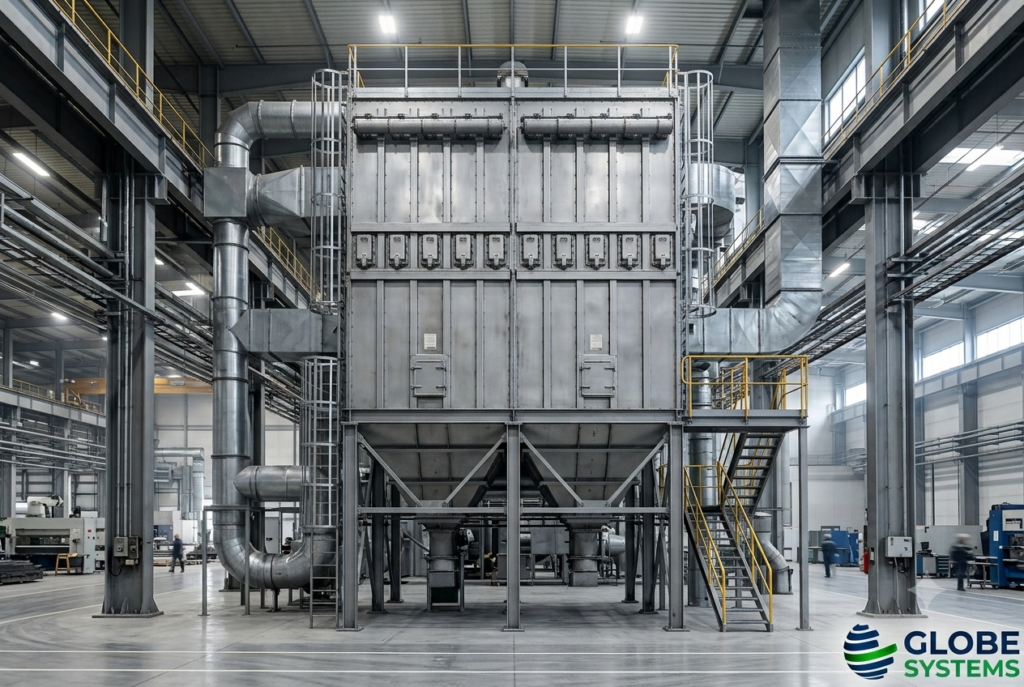
Wherever solids, bulk materials, or powders are processed, dust is generated — and with it, risks to operator health, the environment, and process efficiency itself. The dust collector is the equipment responsible for capturing this airborne particulate matter before it disperses through the plant or is released into the atmosphere. Choosing the right dust collector and sizing it correctly is decisive both for environmental compliance and for a safe, productive work environment.
The dust collector rarely works alone: it is part of a dust-control system that includes capture, ductwork, ventilation, and disposal of the collected material. Learning about the line of environmental control equipment in Globe Systems technologies helps you understand how each piece fits into the whole and why integrated sizing is so important.
What Is an Industrial Dust Collector
The dust collector is a piece of equipment that separates solid particles from the air stream generated in industrial processes. Contaminated air is drawn in at the dust-generation points, carried through ductwork to the collector, where particles are retained and clean air is returned to the environment or released within legal limits. The separation principle varies by collector type: filtration through a porous medium, centrifugal force, or liquid scrubbing.
Types of Dust Collectors
There is no universal collector: each technology best suits certain particle size ranges, flow rates, and dust types. Knowing the options is the first step toward correct specification.
Bag Filter
The bag filter is the most widely used type. Air passes through filter bags that retain fine particulate, and cleaning is done with reverse air pulses. It is the most efficient choice for fine, dry dust. See in detail the bag filter operation and selection guide, which is the heart of most industrial dust-control systems.
Separator Cyclone
The cyclone uses centrifugal force to separate coarser particles, with no filtering elements. It is robust, has low maintenance cost, and is often used as a pre-separator ahead of the bag filter, extending the bags’ service life and reducing the load on the main filter.
Gas Scrubber
The scrubber, or wet collector, captures particles and soluble gases by bringing the air into direct contact with a liquid. It is recommended when there are gases to neutralize, sticky dust, or explosion risk — situations where dry filtration would be neither safe nor efficient.
Cartridge Filter
The cartridge filter uses pleated elements, which offer a large filtering area in a small footprint. It is recommended for fine dust in space-constrained environments, such as paint booths and machining lines. On the other hand, it usually requires more frequent cartridge replacement than bags in high dust-load applications.
Dust Collector Sizing Criteria
An dust collector undersized collector doesn’t capture enough and lets dust escape; an oversized one wastes energy and investment. The balance depends on well-defined technical variables, evaluated together.
How to Size the Dust Collector
Sizing starts from the air flow rate needed to capture dust at each generation point, the particulate’s concentration and particle size, the gas’s temperature and humidity, and the air-to-cloth ratio in the case of bag filters. Each of these factors directly influences the collector’s size, the required filter area, and the associated ventilation system. A good design starts by measuring capture point by point, not by estimating the equipment in isolation.
The air-to-cloth ratio, the ratio between air flow and total bag area, deserves special attention: values that are too high overload the filter medium, increase pressure drop, and reduce the bags’ service life. Total system pressure drop, in turn, directly impacts fan power consumption, making it a key energy-efficiency indicator to be monitored during operation.
| Variable | Influence on Sizing |
|---|---|
| Air flow rate | Defines the collector and duct size |
| Dust particle size | Determines the appropriate collector type |
| Particulate concentration | Impacts filter area and cleaning frequency |
| Temperature and humidity | Define the materials and bag type |
| Explosion risk | Requires specific protection and, sometimes, wet collection |
Need to control dust in your plant efficiently?
Globe Systems sizes the complete dust-control system, based on your process and the real type of dust. Talk to Our Specialists and receive a technical analysis.
Applications and Environmental Compliance
The dust collector is essential in sectors such as mining, cement, food, chemical, timber, and metallurgy. Beyond occupational safety, there is the legal requirement: particulate matter emissions into the atmosphere must comply with the limits set by environmental regulations. Designing the system in compliance with CONAMA Resolution 382/2006, which sets emission limits for fixed sources, avoids fines and protects the plant’s operating license.
In each sector, the challenge changes: in mining and cement, large volumes of abrasive dust predominate; in the food and pharmaceutical industry, sanitary finish and strict cross-contamination control are required; in metalworking and wood, dust explosion risk is added, demanding specific protection design. Recognizing this particularity is what avoids a generic, inefficient system.
Capture, Ventilation, and Dust Disposal
The dust collector is only one part of the system. Just as important are the capture points — hoods, canopies, and nozzles positioned as close as possible to the dust source — and the duct network, which must carry the contaminated air at sufficient velocity so the particulate doesn’t settle along the way. The fan, or exhauster, provides the necessary flow and pressure, and the collected material requires proper disposal: discarding it according to the waste class or, in many cases, reusing it, when the dust has value as a raw material. Designing these steps together is what ensures real dust-control efficiency.
From an occupational standpoint, continuous exposure to fine dust is associated with respiratory diseases, making particulate control also a worker health issue, governed by occupational safety standards. An efficient dust-control system protects both the team and the plant’s equipment, which suffers less from abrasion, dirt, and dust buildup in production areas.
The Globe Systems Solution for Dust Control
Globe Systems designs the dust collector and the entire dust-control system in a consultative, process-based way. Sizing considers the real dust type, capture flow rate, gas temperature, and each plant’s environmental requirements, resulting in efficient capture, low energy consumption, and legal compliance. Every project applies a safety factor and is backed by BNDES accreditation to enable the industrial investment.
The dust collector is an investment in safety, efficiency, and operational continuity. Choosing the right type and sizing it according to the process is what ensures a healthy work environment and a plant that complies with the law. With that, dust control stops being just a cost and becomes part of the plant’s productivity.