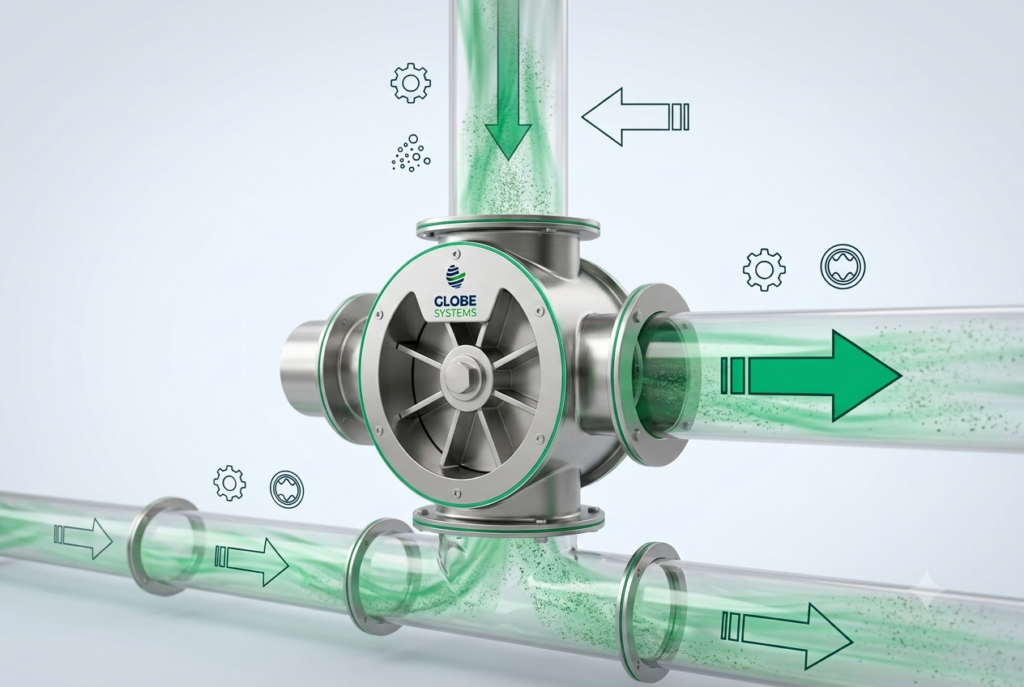
In pneumatic conveying of powders and granulates, there’s a discreet component that makes all the difference between a stable system and one full of losses: the rotary valve. Also called a metering valve or rotary valve, it performs a dual function: feeding the product into the line while, at the same time, maintaining the seal between regions of different pressure. Understanding the function and selection criteria of the rotary valve is essential for designing an efficient, precise conveying system free of air leaks.
The rotary valve works together with the entire pneumatic conveying line and its applications, controlling the material’s entry into the air stream. Without it, or with it poorly sized, the system loses compressed air, wastes energy, and suffers from irregular product metering throughout operation.
What Is the Rotary Valve and What Is Its Function
The rotary valve is composed of a rotor with vanes that spins inside a cylindrical housing. As it rotates, each compartment between the vanes fills with product at the top and discharges it at the bottom, already inside the conveying line. This continuous rotation performs two tasks at once: metering the material at a steady rate and acting as an airlock, preventing pressurized air in the line from escaping back through the feed point.
How the Rotary Valve Acts in Pressure Sealing
Sealing is the component’s most critical point. The clearance between the rotor’s vanes and the housing needs to be small enough to limit air leakage, but not so tight that it generates excessive friction and wear. In dense-phase systems, which operate at higher pressures, the rotary valve requires reinforced construction and even more tightly controlled clearances. It is precisely this balance between sealing and durability that defines the equipment’s proper operation and service life.
Air leakage through the feed point is more than a one-off loss: it reduces conveying velocity in the line, compromises system capacity, and increases compressor consumption. In continuous operation, even a small constant leak represents a significant energy cost over the course of a month, which is why seal integrity is treated as an energy-efficiency item, not just basic system operation.
Types of Rotary Valves
There are different construction variations depending on the application. In direct-passage models (drop-through), the product falls by gravity through the valve. In blow-through models (blow-through), the conveying air passes directly through the base of the valve, carrying the product along — a common solution in dilute-phase systems. There are also heavy-duty constructions, with reinforced rotors and bearings, designed for abrasive products or high-temperature operations. Choosing the correct type starts with the material’s behavior and the process conditions.
The rotor itself allows for important variations: open-vane rotors, simpler and easier to clean; closed-vane rotors, which increase the usable volume per compartment; and rotors with adjustable or beveled tips, which reduce friction and extend sealing life in abrasive products. Rotor selection always goes hand in hand with the material being conveyed and the system’s pressure level, avoiding both leakage and accelerated wear.
Rotary Valve Selection Criteria
Choosing the rotary valve right valve requires evaluating a series of technical factors; ignoring them usually results in loss of efficiency or premature wear:
- Product type: abrasiveness, particle size, flowability, and temperature of the material.
- Required flow rate: defines the valve size and operating speed.
- Pressure differential: the higher it is, the more demanding the required sealing.
- Construction material: carbon steel, stainless steel, or special abrasion-resistant linings.
- Rotor clearance: adjusted to the product and the system’s operating pressure.
To organize the specification, it’s worth relating each variable to its direct impact on the design:
| Criterion | Influence on Valve Selection |
|---|---|
| Product abrasiveness | Defines the rotor’s material and lining |
| Pressure differential | Determines the clearance and structural reinforcement |
| Operating temperature | Impacts materials and clearance expansion |
| Product flow rate | Defines the valve’s size and rotation speed |
| Sanitary requirement | Requires finishing and disassembly for cleaning |
Need to specify the right valve for your system?
Globe Systems sizes every component as part of the conveying system, based on your product and process. Talk to Our Specialists and receive a technical analysis.
Applications and Specification Considerations
The rotary valve is present in practically every segment that handles powders: food, chemical, pharmaceutical, animal nutrition, and mining. In each one, requirements change — in food and pharma, for example, sanitary finish and ease of cleaning are mandatory, while in mining, abrasion resistance carries the most weight. Learn about the full line of solids-handling equipment in Globe Systems technologies, where the valve is sized as part of the system, not in isolation.
The construction and operation of these components must also comply with the technical and safety standards applicable to equipment with moving parts, in line with the guidelines of entities such as ABNT. Specifying in accordance with these references reduces operational risk, standardizes maintenance, and extends the assembly’s service life over the years.
Maintenance and Signs of Wear in the Rotary Valve
Since sealing depends on precise clearances, wear on the rotor and housing is the main enemy of performance over time. Signs such as increased air leakage, declining conveying efficiency, and abnormal noise indicate that clearances have opened beyond tolerable limits. In abrasive products, wear happens faster and requires periodic inspection of the vane tips and the housing’s inner surface. A preventive maintenance program, checking clearances, seals, and bearings, keeps metering accurate and avoids compressed-air losses that drive up operating costs.
The valve’s metering precision also influences downstream processes. In formulation, mixing, or bagging lines, the regularity with which product is introduced into the line directly affects the consistency of the final batch. That’s why, in applications requiring fine flow control, the valve’s rotation is usually controlled by a frequency inverter, allowing the feed to be adjusted to process demand in real time.
The Globe Systems Solution for Metering and Sealing
Globe Systems designs the rotary valve as an integrated part of the pneumatic conveying system, with consultative sizing by process, not by catalog. Selection considers the real product, flow rate, pressure differential, and hygiene requirements of each plant, resulting in efficient sealing, precise metering, and low wear. Every piece of equipment is designed with a safety factor applied and is backed by BNDES accreditation to enable the industrial investment.
The rotary valve is the component that sustains the stability of pneumatic conveying: it meters the product, seals the pressure, and protects the line’s energy efficiency. Specifying it correctly, considering product, pressure, and application, is what separates a reliable system from a constant source of losses and maintenance. It’s worth dedicating time to this choice as early as the design phase.