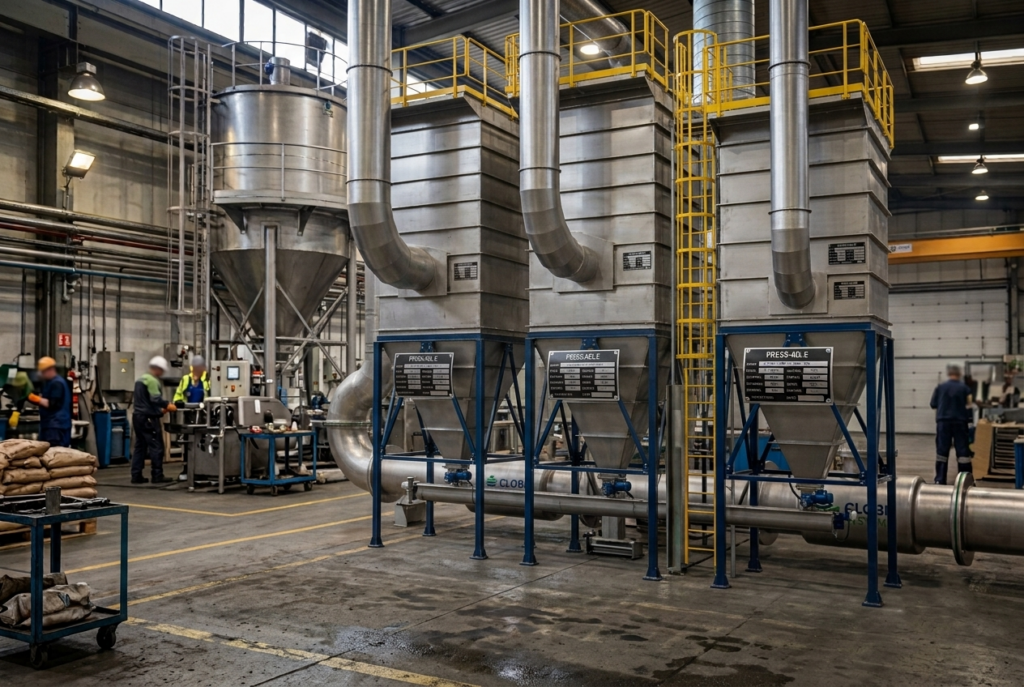
Moving powders, grains, and granulates inside an industrial plant without conveyor belts, without spillage, and in a closed circuit is what a pneumatic conveying system does. It uses moving air, or another gas, inside pipelines to carry material from one point to another. Behind this seemingly simple idea lies a set of components and design criteria that determine whether the pneumatic conveying system will be efficient, economical, and free of clogging throughout operation.
Before getting into the components, it’s worth understanding the general concepts of pneumatic conveying and its applications, which underpin any air-based solids handling project.
What Makes Up a Pneumatic Conveying System
A pneumatic conveying system complete system is much more than a pipe and a blower. It integrates air generation, product feeding, the conveying line, and final separation, each part with a specific function and its own sizing. The performance of the whole depends on the balance between all of them.
Main Components of a Pneumatic Conveying System
- Air source: a roots-type blower, compressor, or vacuum pump, which generates the conveying flow and pressure.
- Feeding: rotary valve, ejector, or pressure vessel, which introduces the product into the line in a controlled manner.
- Piping: the conveying line, with bends and diverters designed to minimize wear and pressure loss.
- Separation: cyclone, bag filter, or silo, which separates the product from the air at the destination point.
- Control: valves, instrumentation, and automation that ensure stable, safe operation.
Dense Phase and Dilute Phase
There are two main operating regimes. In dilute phase, the product is carried in suspension by a high-velocity, low-pressure air stream — a simple, versatile solution ideal for most non-abrasive powders. In dense phase, material is pushed in “plugs” at low velocity and high pressure, which reduces friction and product breakage, and is recommended for fragile or abrasive materials. The choice between the two defines the rest of the system design.
Air velocity is the most sensitive variable in the whole system. Insufficient velocity causes the product to settle and clog the line; excessive velocity accelerates wear on the bends and generates fines through friction. There is, therefore, an ideal range for each material, which must be respected along the entire path, also considering that air expands and accelerates as pressure drops along the line.
Positive Pressure and Vacuum Systems
The system can operate by positive pressure, pushing the product with air from the origin, or by vacuum, pulling the product by suction. Pressure systems are efficient for long distances and for a single feed point supplying multiple destinations; vacuum systems are ideal for collecting product from multiple points to a single destination, and since they work under negative pressure, they prevent dust from escaping into the environment — an important advantage in applications requiring strict hygiene.
Design Criteria for a Pneumatic Conveying System
Designing a pneumatic conveying system requires balancing several variables; an error in any one of them compromises efficiency or causes clogging in the line.
| Variable | Influence on Design |
|---|---|
| Product type | Defines the phase, velocity, and materials |
| Distance and height | Determine the required pressure and power |
| Desired flow rate | Sizes the piping and the air source |
| Abrasiveness | Defines the line’s thickness and lining |
| Product fragility | Indicates dense phase to avoid breakage |
Among the most important design considerations is the treatment of bends, which are the points of greatest wear and highest risk of clogging. Long-radius bends, abrasion-resistant linings, and correct control of air velocity help extend the line’s life and preserve product integrity. The generation of fines through friction, undesirable in many processes, is also minimized by properly adjusting conveying velocity.
The most common operating problems almost always originate in the design. Clogging usually comes from low velocity, poorly positioned bends, or irregular feeding; premature wear, from high velocity or unsuitable piping material; and excessive fines generation, from the wrong conveying regime for a fragile product. Diagnosing the root cause requires looking at the system as a whole, not just the point where the symptom appears.
Sizing the air source deserves special attention, since it consumes the most energy. Undersizing the blower compromises conveying capacity; oversizing wastes energy continuously. The correct calculation starts from product flow rate, distance, elevation change, and line pressure losses, balancing capacity and consumption for the entire operating cycle.
Need a reliable handling system for your powders?
Globe Systems designs the complete system, sized for your product and your plant layout. Talk to Our Specialists and receive a technical analysis.
Advantages and Applications
The pneumatic conveying system offers closed-circuit conveying, with no contamination or product loss, flexible three-dimensional layout, low maintenance, and excellent suitability for environments requiring hygiene. It is used in food, pharmaceuticals, chemicals, cement, animal nutrition, and mining. Learn about the full line in Globe Systems technologies, where each system is designed according to the product and plant layout, in compliance with applicable technical standards, such as those from ABNT.
Compared to mechanical systems such as bucket elevators and screw conveyors, air conveying eliminates moving parts along the route, reduces contamination points, and makes it easy to route around plant obstacles. In exchange, it requires a precise design, since energy efficiency depends directly on correctly sizing the air source and operating velocity.
Because it has few moving parts along the route, the system usually requires little maintenance, concentrated on the air source, the feed valve, and the bends most exposed to wear. Periodic inspection of these points, together with continuous monitoring of line pressure, anticipates failures and maintains efficiency over the operating lifetime.
The Globe Systems Solution
At the destination, efficient product separation is also part of the design: a well-sized cyclone or bag filter ensures the conveying air exits clean and the product is recovered without losses, directly connecting the conveying system to the plant’s environmental control. This is one more reason to design the whole system in an integrated way.
Globe Systems designs the pneumatic conveying system in a consultative, process-based way, sizing phase, velocity, piping, and components based on the real product and the plant layout. The result is an efficient system with low wear, minimal fines generation, and stable operation. Every project applies a safety factor and is backed by BNDES accreditation to enable the industrial investment.
A pneumatic conveying system, when well designed, is the difference between a reliable handling line and a constant source of clogging and losses. Correctly defining the phase, components, and design criteria is what ensures efficiency, hygiene, and low operating cost over years of use. It’s a design decision that pays for itself over time.